
Sidebar
Table of Contents
206A - Airway Navigation
Intercepting and Tracking IFR Courses
Changeover Point on an airway (AIM 5-3-6)
IFR Departure Procedures (SIDs and DPs)
IFR Arrival Procedures (STARs)
GPS Direct to Navigation
Holding Pattern Entry Procedures-Direct, Parallel, and Teardrop
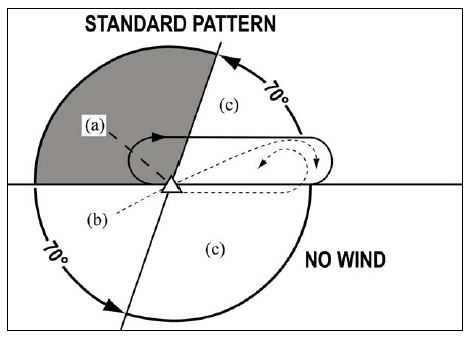
Direct Entry Procedure When approaching the holding fix from anywhere in sector ©, the direct entry procedure would be to fly directly to the fix and turn to follow the holding pattern.
Parallel Procedure When approaching the holding fix from anywhere in sector (a), the parallel entry procedure would be to turn to a heading to parallel the holding course outbound on the nonholding side for one minute, turn in the direction of the holding pattern through more than 180 degrees, and return to the holding fix or intercept the holding course inbound.
Teardrop Procedure When approaching the holding fix from anywhere in sector (b), the teardrop entry procedure would be to fly to the fix, turn outbound to a heading for a 30 degree teardrop entry within the pattern (on the holding side) for a period of one minute, then turn in the direction of the holding pattern to intercept the inbound holding course.
Holding Patterns
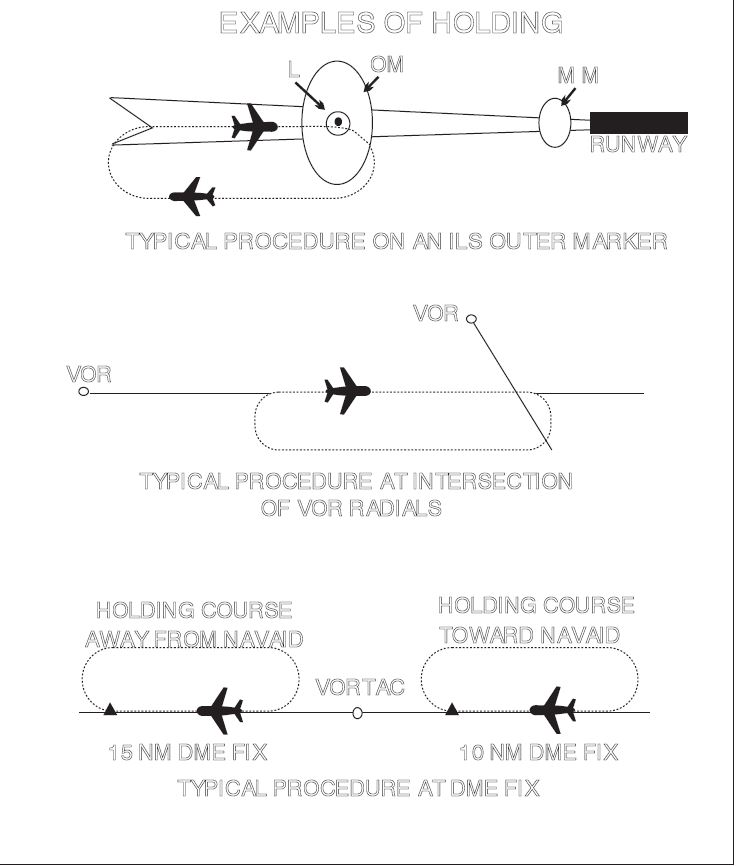
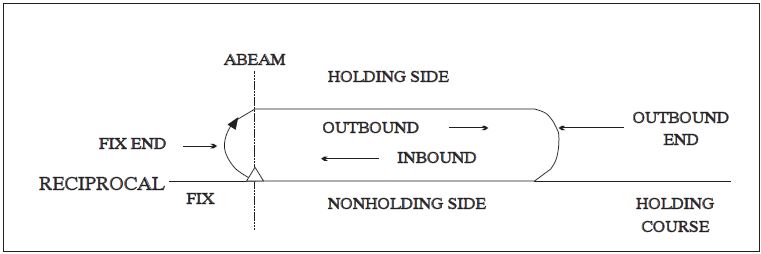

Timing Holds
Inbound Leg
(1) At or below 14,000 feet MSL: 1 minute.
(2) Above 14,000 feet MSL: 11/2 minutes.
The initial outbound leg should be flown for 1 minute or 1 1/2 minutes (appropriate to altitude). Timing for subsequent outbound legs should be adjusted, as necessary, to achieve proper inbound leg time. Pilots may use any navigational means available; i.e., DME, RNAV, etc., to ensure the appropriate inbound leg times.
Outbound leg timing begins over/abeam the fix, whichever occurs later. If the abeam position cannot be determined, start timing when turn to outbound is completed.
Intersection Holding Patterns - Dual VOR, Single VOR, DME Fix
Unpublished Holds


