
Sidebar
This is an old revision of the document!
Table of Contents
206B - Flight Planning
Instrument Flying Handbook Ch. 10
IFR Flight Plan Requirements
As specified in Title 14 of the Code of Federal Regulations (14 CFR) part 91, no person may operate an aircraft in controlled airspace under IFR unless that person has filed an IFR flight plan.
FAR 91.169 - IFR Flight Plans Must provide information required by FAR 91.153: Aircraft ID, type, pilot, departure point, departure time, route, altitude, TAS, destination, time en-route, fuel on board, souls on board, and “any other information the PIC or ATC believes is necessary for ATC purposes.”
Chart Supplement & NOTAMs
- Preferred Routes
- FSS telephone numbers
- FSS communications frequencies
- FSDO contact informaiton
- VOT locations & information
- Airport Diagrams (and legend for diagrams)
- Hot spot details
- Weather radar locations
- Airport information
NOTAMs
Check FDC NOTAMs for information on IFR operations.
Sample NOTAM:
!FDC 8/4953 MDH IAP SOUTHERN ILLINOIS, Carbondale/Murphysboro, IL.
ILS OR LOC RWY 18L, AMDT 13... S-LOC 18L MDA 800/HAT 393 ALL CATS.
VIS CAT C 3/4, CAT D 1.
DISREGARD NOTE: FOR INOPERATIVE MALSR, INCREASE S-LOC 18L CAT D
VISIBILITY TO 1 MILE. NOTE: NIGHT LANDING: RWY 6, 36L NA.
1802012219-1809132219EST
Preferred IFR Routes
- Contained within the Chart Supplement publication.
- Broken into high altitude & low altitude routes.
- Generally involve major terminal areas.
- May incorporate SIDs/STARs as well as IAPs rather than providing full routing to/from airports listed.
- Some low routes have effective times (listed in UTC). All high altitude routes are timed, unless noted.
Sun...0300 - 2259L
M-F...0701 - 2259L
Sat...0701 - 1459l
Sample Preferred Route
Departure Point: Springfield Capital (SPI)
Destination: Tulsa International (TUL)
V50 UIN V63 SGF V14
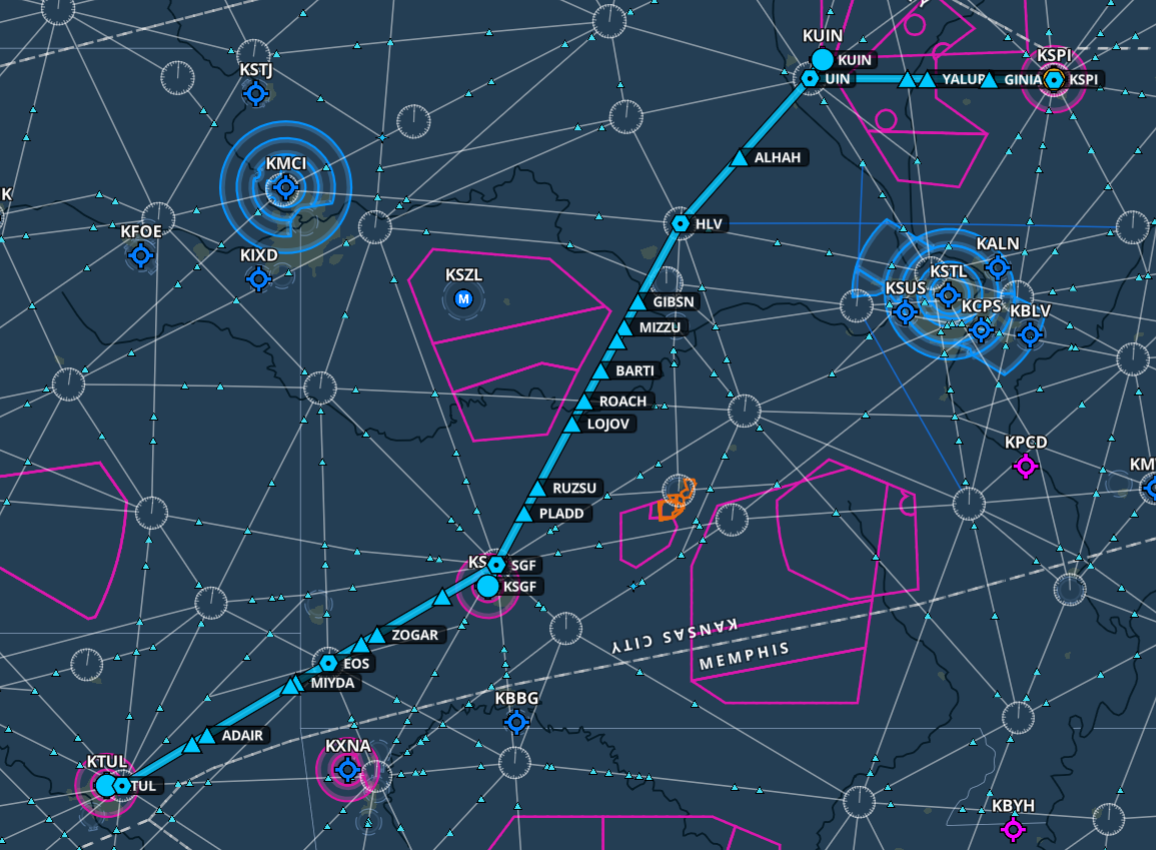
How do you get from the TUL VOR to the airport?
IFR Departure Procedures (SIDs & DPs)
Preplanned to provide obstacle clearance.
Provide a way for the pilot to safely transition to the en-route system.
There are two types of DPs: Obstacle Departure Procedures (ODP), printed either textually or graphically, and Standard Instrument Departures (SID), always printed graphically.
Why is an DP necessary? - The primary reason is to provide obstacle clearance protection information to pilots. A secondary reason, at busier airports, is to increase efficiency and reduce communications and departure delays through the use of SIDs. (AIM 5-2-8 a)
Obstacle DPs are necessary when an object penetrates the “40:1 obstacle identification surface.”
- Begins at the end of the departure runway
- Slopes upward at 152 FPNM until min IFR altitude
- Limited to 25NM from airport or 46NM from airport in mountainous terrain.
- Beyond this distance, pilot is responsible for terrain clearance if not on a route or above a MEA, MOCA, or ATC assigned altitude.
See MDH DP.
SID
Published arrival route to reduce clearances and congestion.
x
IFR Arrival Procedures (STARs)
IFR Flight Planning - Victor Airways
Low Altitude airways - 1200' AGL to FL180
IFR Off-Route Flight Planning
Minimum IFR Altitudes
MEA - Minimum Enroute Altitude (victor airway)
- ATC communication ability
- Nav station coverage
- Safe clearance
- Adherence to procedures
MOCA - Minimum Obstacle Clearance Altitude
- 1000ft separation or 2,000ft separation in mountainous areas
- MOCA assures also 22NM VOR reception range
MSA - Minimum Sector Altitude
- Approach plates
- Within 25NM of a fix
- 300ft seperation
MRA - Minimum Reception Altitude
OROCA - Off Route Obstruction Clearance Altitude
- OROCA is computed just as the Maximum Elevation Figure (MEF) found on Visual Flight Rule (VFR) Charts except that it provides an additional vertical buffer of 1,000 feet in designated non-mountainous areas and a 2,000 foot vertical buffer in designated mountainous areas within the United States.
MAA - Maximum Authorized Altitude
- maximum usable altitude or flight level for an airspace structure or route segment
MTA - Minimum Turning Altitude - charted altitude providing vertical and lateral obstruction clearance based on turn criteria over certain fixes, NAVAIDs, waypoints, and on charted route segments
MCA - Minimum Crossing Altitude
- lowest altitude at certain fixes at which the aircraft must cross when proceeding in the direction of a higher minimum enroute IFR altitude
Alternate Airport Requirements
Clearance Procedures - Towered & Non-Towered
Crew Resource Management & Coordination


