Sidebar
Table of Contents
Aerodynamics - 207A
Four Forces of Flight
S&L Flight – Opposing Forces are Equal
- The sum of all upward components of forces (not just lift) equals the sum of all downward components of forces (not just weight)
- The sum of all forward components of forces (not just thrust) equals the sum of all backward components of forces (not just drag)
Thrust – The aircraft continues to move and gain speed until thrust and drag are equal.
Lift – The pilot can control the lift. Any time the control yoke or stick is moved fore or aft, the AOA is changed. As the AOA increases, lift increases (all other factors being equal).
Warm air is less dense than cool air, and moist air is less dense than dry air. Thus, on a hot humid day, an aircraft must be flown at a greater true airspeed for any given AOA than on a cool, dry day.
Drag
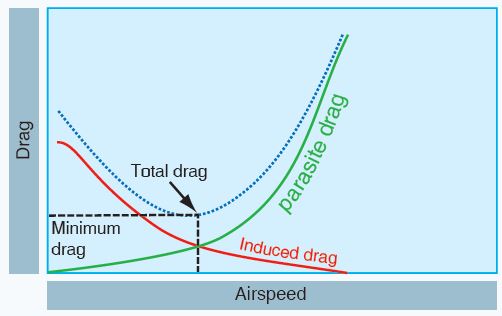
Parasite Drag - Drag not associated with the production of lift. All factors that work to slow the aircraft.
Form Drag - Aircraft shape/structure
Interference Drag - intersection of airstreams that creates eddy currents, turbulence, or restricts smooth airflow
Skin Friction Drag -
Lift/Drag Ratios
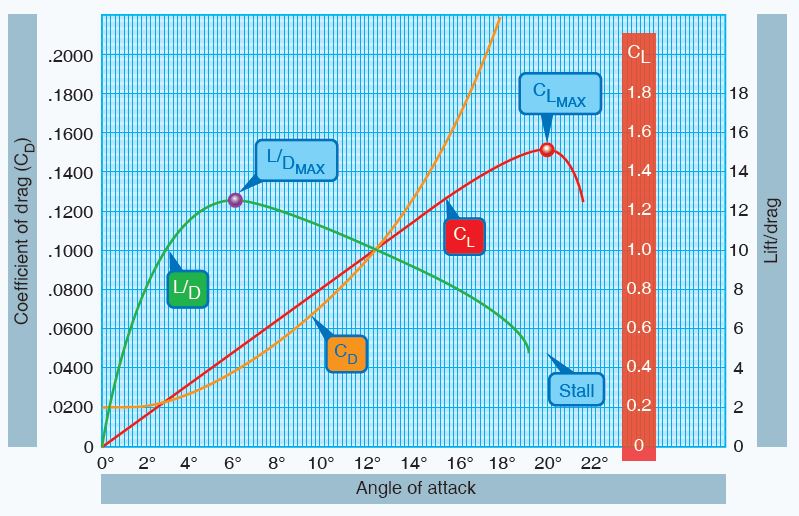
The lift-to-drag ratio is the lift required for level flight (weight) divided by the drag produced at the airspeed and angle of attack required to produce that lift. The L/D ratio for a particular angle of attack is equal to the power-off glide ratio.
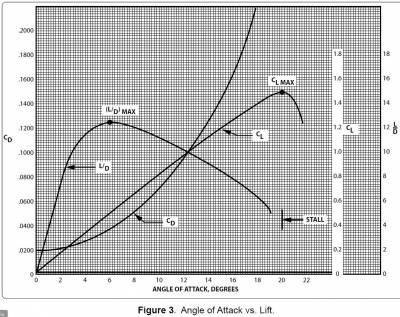
Problem: Refer to FAA Figure 3. If an airplane glides at an angle of attack of 10°, how much altitude will it lose in 1 mile?
Solution:
- Enter the L/D chart from the bottom at a 10° angle of attack.
- Proceed vertically upward until intersecting the L/D curve.
- Follow the horizontal reference lines to the right to the point of intersection with the glide ratio scale. L/D at 10° angle of attack = 11.0.
- 5,280 feet ÷ 11 = 480 foot altitude loss.
L/DMAX occurs at the angle of attack that gives maximum glide performance and maximum range in a propeller driven aircraft. At an airspeed slower (or at a higher angle of attack) than needed for L/DMAX, the glide distance will be reduced due to the increase in induced drag.
Forces During Turns

Forces During Climbs/Descents
Forces During Slow Flight
When the airspeed is low, the AOA must be relatively high if the balance between lift and weight is to be maintained.
Aircraft Turning Tendencies
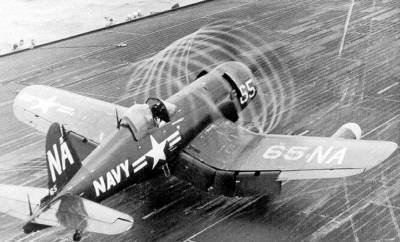
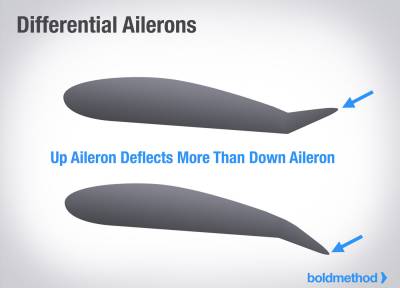
Adverse Yaw
Aircraft Stability, Maneuverability, and Controllability
Manoeuvrability: What the aircraft can do.
Controllability: How well you are able to control what it actually does.
An unstable aircraft can be very maneuverable, but if it is unstable to the point of being out of control most of the time, the controllability is poor. You can't employ the maneuverability to do what you want to achieve as you it is not controllable
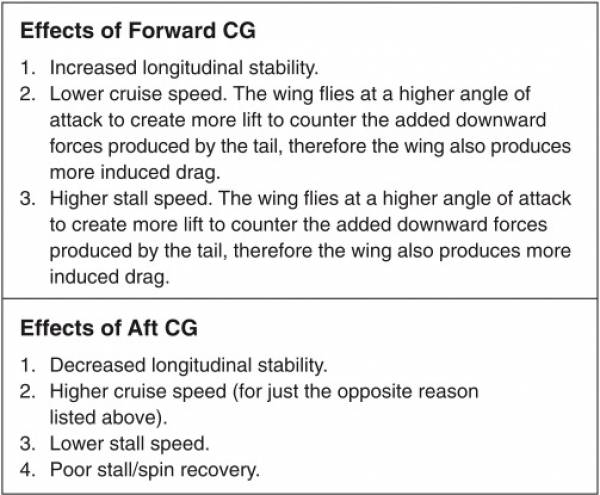
Effects of CG on Drag/Lift