
Sidebar
Table of Contents
Spatial Disorientation and Illusions
Spatial disorientation specifically refers to the lack of orientation with regard to the position, attitude, or movement of the airplane in space. The body uses three integrated systems that work together to ascertain orientation and movement in space.
- Vestibular system—organs found in the inner ear that sense position by the way we are balanced
- Somatosensory system—nerves in the skin, muscles, and joints that, along with hearing, sense position based on gravity, feeling, and sound
- Visual system—eyes, which sense position based on what is seen
The Leans – when a banked attitude, to the left for example, may be entered too slowly to set in motion the fluid in the “roll” semicircular tubes.
Coriolis Illusion – The pilot has been in a turn long enough for the fluid in the ear canal to move at the same speed as the canal.
Graveyard Spiral
As in other illusions, a pilot in a prolonged coordinated, constant-rate turn may experience the illusion of not turning. During the recovery to level flight, the pilot will then experience the sensation of turning in the opposite
Somatogravic Illusion
A rapid acceleration, such as experienced during takeoff, stimulates the otolith organs in the same way as tilting the head backwards. This action may create what is known as the “somatogravic illusion” of being in a nose-up attitude, especially in conditions with poor visual references. The disoriented pilot may push the aircraft into a nose-low or dive attitude. A rapid deceleration by quick reduction of the throttle(s) can have the opposite effect, with the disoriented pilot pulling the aircraft into a nose-up or stall attitude.
Inversion Illusion
An abrupt change from climb to straight-and-level flight can stimulate the otolith organs enough to create the illusion of tumbling backwards, known as “inversion illusion.” The disoriented pilot may push the aircraft abruptly into a noselow attitude, which may intensify this illusion.
Elevator Illusion
An abrupt upward vertical acceleration, as can occur in an updraft, can stimulate the otolith organs to create the illusion of being in a climb. This is known as “elevator illusion.” The disoriented pilot may push the aircraft into a nose-low attitude. An abrupt downward vertical acceleration, usually in a downdraft, has the opposite effect with the disoriented pilot pulling the aircraft into a nose-up attitude.
Visual Illusions
False Horizon
A sloping cloud formation, an obscured horizon, an aurora borealis, a dark scene spread with ground lights and stars, and certain geometric patterns of ground lights can provide inaccurate visual information, or “false horizon,” when attempting to align the aircraft with the actual horizon. The disoriented pilots as a result may place the aircraft in a dangerous attitude.
Autokinesis
When flying in the dark, a stationary light may appear to move if it is stared at for a prolonged period of time. As a result, a pilot may attempt to align the aircraft with the perceived moving light potentially causing him/her to lose control of the aircraft. This illusion is known as “autokinesis.”
Coping with Spatial Disorientation
To prevent illusions and their potentially disastrous consequences, pilots can:
- Understand the causes of these illusions and remain constantly alert for them. Take the opportunity to experience spatial disorientation illusions in a device, such as a Barany chair, a Vertigon, or a Virtual Reality Spatial Disorientation Demonstrator.
- Always obtain and understand preflight weather briefings.
- Before flying in marginal visibility (less than 3 miles) or where a visible horizon is not evident, such as flight over open water during the night, obtain training and maintain proficiency in aircraft control by reference to instruments.
- Do not fly into adverse weather conditions or into dusk or darkness unless proficient in the use of flight instruments. If intending to fly at night, maintain night-flight currency and proficiency. Include crosscountry and local operations at various airfields.
- Ensure that when outside visual references are used, they are reliable, fixed points on the Earth’s surface.
- Avoid sudden head movement, particularly during takeoffs, turns, and approaches to landing.
- Be physically tuned for flight into reduced visibility. Ensure proper rest, adequate diet, and, if flying at night, allow for night adaptation. Remember that illness, medication, alcohol, fatigue, sleep loss, and mild hypoxia are likely to increase susceptibility to spatial disorientation.
- Most importantly, become proficient in the use of flight instruments and rely upon them. Trust the instruments and disregard your sensory perceptions.
Optical Illusions
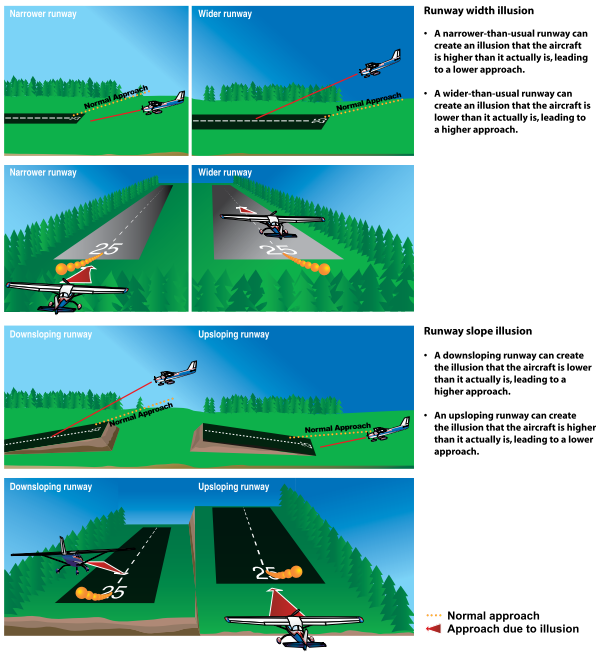
Runway Width Illusion – A narrower-than-usual runway can create an illusion that the aircraft is at a higher altitude than it actually is
Runway and Terrain Slopes Illusion – An upsloping runway, upsloping terrain, or both can create an illusion that the aircraft is at a higher altitude than it actually is.
Featureless Terrain Illusion – An absence of surrounding ground features, as in an overwater approach over darkened areas or terrain made featureless by snow, can create an illusion that the aircraft is at a higher altitude than it actually is.
Water Refraction – Rain on the windscreen can create an illusion of being at a higher altitude due to the horizon appearing lower than it is.
Haze – Atmospheric haze can create an illusion of being at a greater distance and height from the runway. As a result, the pilot has a tendency to be low on the approach.
Fog – Flying into fog can create an illusion of pitching up. Pilots who do not recognize this illusion often steepen the approach abruptly


